


May 16, 2026 • 6 min read
What Is Video Production? The 2026 Complete Guide

Bring Your Vision to Life
Scale Your Content with AI Video Creation.
Video production is one of those terms that means everything and nothing at the same time. Ask ten people in a room what it involves and you’ll get ten different answers. Some will describe Hollywood film sets, others will think of YouTube channels, and a few will mention the brand video their company commissioned last year.
All of them are right. And that’s part of why understanding video content creation properly matters more than ever in 2026, because the decisions brands make about how, where, and why they produce video have real commercial consequences.
This guide explains what video production actually is, how it works, what the different stages involve, and what’s changed with the rise of AI-powered production.
What Is Video Production?
Video production is the complete process of creating a video, from the initial idea through to the finished piece delivered for its intended platform and audience.
The term covers an enormous range of output: a two-minute brand film for a technology company’s homepage, a 30-second product ad running on TikTok, a six-part training series for a logistics company’s onboarding programme, a documentary, a music video, a social media reel. The formats, budgets, and audiences are wildly different. The underlying process that produces them shares the same fundamental structure.
That structure is divided into three stages: pre-production, production, and post-production. Understanding what happens at each stage and why each one matters is the foundation for commissioning, producing, or evaluating video content effectively.
The Three Stages of Video Production

Stage 1: Pre-Production
Pre-production is everything that happens before a single frame is captured. It’s the planning, strategy, and preparation stage, and it’s the one most often underinvested in, particularly by businesses new to video.
The work done in pre-production determines what gets filmed, how it gets filmed, and whether the final result has any chance of achieving its intended purpose. A well-executed pre-production phase produces clarity: everyone involved, including the client, director, crew, and talent, understands what the video needs to achieve, how it will be structured, and what the finished piece should feel like.
Pre-production typically involves:
Briefing and strategy: Defining the video’s objective, target audience, distribution platforms, tone, and success criteria. A video that hasn’t been briefed clearly doesn’t have a clear purpose, and a video without a clear purpose rarely achieves one.
Scriptwriting: For any video with spoken content, the script is the foundation. The quality of a script has more influence on the effectiveness of a finished video than almost any other single factor. A well-written script is conversational, specific, and structured around the audience’s needs rather than the company’s features.
Storyboarding and shot planning: Mapping the visual language of the video to the script, establishing what will be shown and not just what will be said. For complex productions, this involves detailed storyboards. For shorter formats, a shot list serves the same purpose.
Casting and location scouting: Identifying and securing the talent and locations required for the production. For AI-powered production, this stage involves selecting generative visual references and establishing the aesthetic direction through reference imagery.
Scheduling and logistics: Coordinating all elements including crew, equipment, locations, and talent around a production timeline. Budget allocation typically happens here too, with costs distributed across the three stages.
The time invested in pre-production almost always pays for itself. Productions that skip or compress this stage tend to either run over budget during filming, require expensive reshoots, or deliver a finished piece that doesn’t match what the client actually needed.
Our discovery process is the most important part of any project we take on. Before we discuss anything creative, we work through five questions with every client: who is the audience, what do we want them to feel, what do we want them to do, where will this video live, and what does success look like? The projects that skip these questions are the ones that end up needing the most revisions, not because the production was poor, but because the goal wasn’t defined clearly enough to evaluate the work against.
Stage 2: Production
Production is the stage where the video’s raw material is captured, either through traditional filming or, increasingly, through AI generation tools.
In traditional production, this means a shoot: a director, a camera operator, lighting, sound, locations, and talent. The production stage translates the script and storyboard into footage, producing the raw visual and audio material that post-production will shape into the finished piece.
The key principle of production, regardless of method, is that raw material is captured with intent. Every shot, every angle, every take exists to serve a specific purpose in the final edit. Productions that approach the shoot day without this discipline, filming broadly and hoping to assemble something coherent in post, consistently produce weaker results and longer, more expensive post-production processes.
In AI-powered production, the capture stage is replaced by generation. Generative video tools produce cinematic visual material from text prompts, reference images, and creative direction, without a camera, crew, or physical location. This changes the economics of production significantly. According to Ngram’s 2026 AI Video Statistics, AI video tools bring production costs down to approximately $2 to $30 per finished minute on subscription plans, compared to $1,000 to $50,000 per minute for traditional production depending on complexity.
Hybrid approaches combine both methods, using AI-generated environments or visual sequences alongside real presenter footage, location shots, or documentary material. This is increasingly common in corporate video production where the brand requires real faces and authentic environments but needs to manage production costs.
Stage 3: Post-Production
Post-production is where the raw material, whether filmed footage or AI-generated sequences, is shaped into the finished video. It covers editing, colour grading, motion graphics, music, sound design, and mastering.
It is also where most of the quality in a finished video is actually determined.
This is the stage most consistently underestimated by businesses commissioning video for the first time. The assumption is often that post-production is tidying up, cutting the footage together and adding music. In practice, post-production is where the emotional register of a video is set, where the pacing is constructed, where the visual identity is established through colour, and where the sound design creates the atmosphere that carries the viewer through the piece.
According to Technavio’s Post Production Market analysis, the global post-production market is expected to grow by $18.2 billion between 2026 and 2030 at a 12.9% CAGR, which is faster than the overall production market. This reflects the increasing recognition of post-production as a value-generating stage, not just a finishing one.
Post-production for AI-generated content follows the same principles as traditional post-production, with the same requirement for craft and attention. The gap between an AI video that looks polished and professional and one that looks like a rough demo output is almost entirely determined by the quality of post-production applied to it.
Post-production is where AI video either becomes cinematic or stays rough. The generation tools produce the material. The editorial work, including pacing, colour, sound design, and finishing, is what makes it feel like something worth watching. We never skip this stage, and we don’t compress it. It’s where the work actually happens.
Types of Video Production
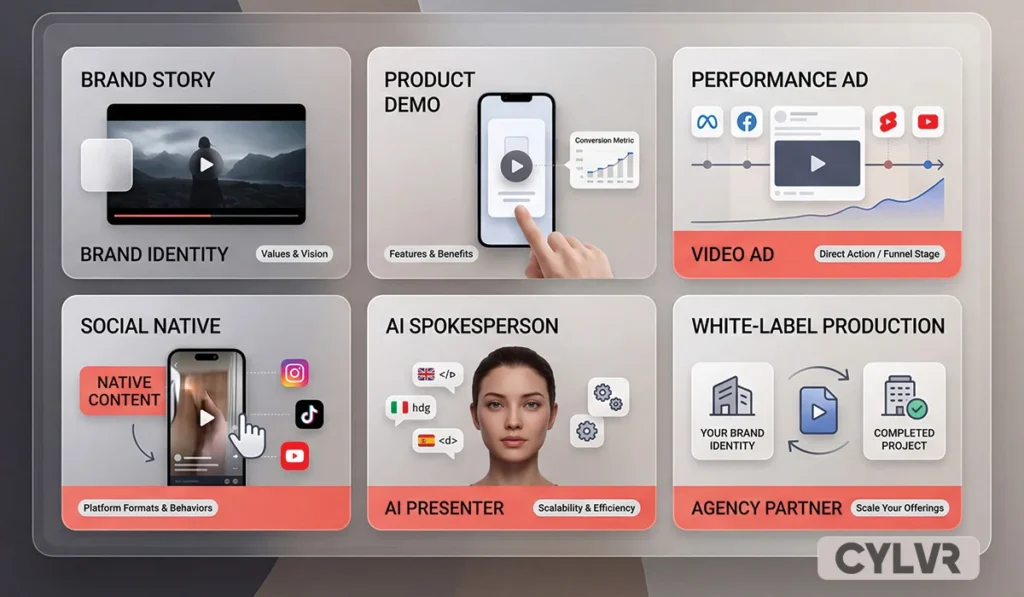
Video production encompasses a wide range of formats, each suited to different business objectives and audience contexts.
Brand Film Production
A brand film communicates who a company is, what it stands for, and why it exists. It’s not a product demo or an ad. It’s the emotional and philosophical foundation of the brand, told visually. Brand films typically live on homepages, in investor presentations, and as evergreen social content.
Product Video Content Production
Product videos demonstrate what a product does, who it’s for, and what it makes possible. For eCommerce brands, product videos on listing pages consistently drive conversion improvements. For SaaS companies, a clear homepage demo removes the friction that kills sign-ups before they start.
Video Ad Production
Video ads are performance-oriented, built to drive a specific action at a specific stage of the funnel. The format, pacing, and creative approach vary significantly depending on the platform: a Meta video ad and a YouTube pre-roll operate under different rules, for different viewer behaviours, and require different production approaches.
Social Media Video Creation
Social media video is platform-native content designed for the specific behaviours, formats, and audience expectations of Instagram Reels, TikTok, LinkedIn, and YouTube Shorts. Content repurposed from longer formats and cropped to fit performs substantially worse than content built for the platform from the first frame.
AI Spokesperson Video Production
AI spokesperson videos use synthetic on-screen presenters to deliver scripted content at scale. They’re particularly suited to training content, product walkthroughs, FAQ videos, and multilingual communications, where the efficiency and scalability advantages of AI generation are most commercially significant.
White-Label Video Creation
White-label video production is the production of video content on behalf of another agency or brand, delivered under that agency’s identity. It allows agencies to scale their video offering without building an in-house production capability.
How Much Does Video Production Cost?
Video production costs vary enormously depending on format, approach, complexity, and the quality of creative and post-production talent involved.
As a general guide for 2026:
| Format | Traditional Production | AI-Powered Production |
| 60-second brand film | $8,000 to $25,000 | $2,500 to $6,000 |
| Product demo video | $5,000 to $15,000 | $1,500 to $4,500 |
| Training video (per module) | $3,000 to $10,000 | $800 to $2,500 |
| AI spokesperson video | N/A | $1,000 to $3,000 |
| Social media package (5 videos) | $10,000 to $30,000 | $2,500 to $7,500 |
The four main cost drivers across all production approaches are talent, location, post-production complexity, and timeline. Rush projects carry a premium regardless of method.
The Video Production Industry in 2026
Video production is a large and rapidly growing industry. The global film and video market was valued at $361.36 billion in 2025 and is expected to reach $383.58 billion in 2026, growing at a compound annual growth rate of 6.1%. By 2030, the market is projected to hit $489.55 billion — growth driven by the expansion of OTT streaming platforms, AI-assisted content creation, rising global demand for multilingual content, and the increasing adoption of 4K and 8K video technologies
The growth is driven by several converging factors: streaming platform investment, the expansion of social media video advertising, the adoption of AI production tools, and the increasing volume of video content businesses are expected to produce across channels.
For most businesses in 2026, video production is no longer a campaign-level decision made once or twice a year. It’s an ongoing communication channel requiring consistent output, faster turnaround times, and more formats than traditional production workflows were designed to support.
Ready to see what AI-powered video production looks like for your brand?
Cylvr produces brand films, product videos, and corporate content for businesses across the US, UK, and UAE, delivered in 5 to 14 days. Start with the First Frame: a complimentary custom video sample built for your brand before you commit to anything.
How AI Has Changed Video Production
Artificial intelligence has been integrated into video production workflows in various forms for several years. What changed significantly around 2024 and 2025 was output quality, and with it, the practical economics of video creation for businesses of all sizes.
According to Ngram’s 2026 AI Video Statistics, the AI video generator market reached $716.8 million in 2025 and is projected to hit $847 million in 2026, growing at 18.8% CAGR and roughly 3.6 times faster than the broader video editing software market.
The practical implications for businesses commissioning video are significant across three dimensions.
Cost. AI production tools have reduced per-unit production costs dramatically, making professional-quality video accessible to brands that previously couldn’t justify the investment for traditional studio production.
Speed. Traditional corporate video production typically runs on a four to eight week timeline. AI-powered production compresses this to five to fourteen days for most formats, which is a meaningful operational difference for teams working around campaign windows or product launches.
Volume. The combination of lower cost and faster turnaround enables brands to produce more content more consistently, testing across formats and platforms in a way that’s practically impossible with traditional production timelines and budgets.
Importantly, AI is not replacing traditional video production. The traditional production market continues to grow. What AI has created is a new category of content, including the internal training update, the product walkthrough, and the weekly social clip, that previously existed as documents or slides and is now produced as video.
[CYLVR POV] We built our production model around AI generation combined with professional creative direction and post-production finishing, because neither alone produces the result. The technology handles speed and cost. The editorial craft handles quality. When both are done well, the output is genuinely difficult to distinguish from traditionally filmed content, and it gets delivered in a fraction of the time.
What Good Video Production Actually Requires
Understanding the three stages of video production is useful context. Understanding what separates strong production from weak production is more useful still.
A clear brief.
Every production decision flows from the brief. Who is this for, what should they feel, what should they do. These questions determine the format, the tone, the pacing, and the distribution. Productions that begin without clear answers to them tend to end with content that looks professional but achieves nothing in particular.
Scripting treated as a craft.
The script is the most leveraged document in video production. A well-written script produces a clear, engaging video. A vague or poorly structured script produces a video that is technically polished but functionally ineffective. Budget for scriptwriting, because it pays for itself.
Post-production given the time it requires.
The single most common way a solid production arrives at a mediocre result is a compressed post-production timeline. Editing, colour grading, sound design, and finishing are not formalities. They’re where the emotional quality of the video is constructed.
Distribution defined before production begins
A video produced for a website homepage will underperform as a TikTok, and a TikTok will underperform as a sales deck asset. The platform shapes the format, the aspect ratio, the pacing, and the call to action. Distribution should be part of the brief, not an afterthought.
A production partner with genuine strategic capability
Technical quality and strategic alignment are different things. The most common mistake in commissioning video is choosing a partner based on visual quality alone, without assessing whether they understand the business objective the video needs to serve.
Video Production for Different Industries
Video production serves different purposes across different industries, and the most effective content is built around the specific context, audience, and objectives of the sector it’s produced for.
eCommerce brands use product videos and performance ad creative to drive conversion directly from listing pages and paid social campaigns. The format, length, and opening hook are shaped entirely by the platform’s audience behaviour and the stage of the funnel the content is targeting.
SaaS and technology companies use explainer videos, product demos, and onboarding content to reduce friction at critical points in the customer journey, from the homepage through to post-purchase adoption.
Real estate businesses use property films, development launch content, and agent brand videos to build credibility and generate qualified enquiries in a category where trust is a primary purchase driver.
Food and restaurant brands use cinematic product and brand content to create appetite appeal and brand affinity, in formats where production quality and visual craft directly affect commercial outcomes.
Marketing agencies use white-label video production to scale their video offering without building an in-house production capability, delivering client video under their own brand through a confidential production partnership.
Not sure what type of video your brand actually needs?
Walk us through your project in four steps. Cylvr will recommend the right format, the right approach, and an honest cost estimate before you commit to anything.
Frequently Asked Questions
The Bottom Line on Video Production
Video production is a broad discipline, covering formats from 15-second social clips to multi-part documentary series, and approaches from traditional studio production to fully AI-generated content with professional post-production finishing.
What unifies all of it is process. The productions that consistently deliver strong results, regardless of format, budget, or method, are the ones built on a clear brief, a disciplined creative development process, and post-production given the time it requires to do its job properly.
In 2026, the practical barriers that once made professional video inaccessible for smaller budgets have reduced substantially. AI-powered production has brought the cost and timeline of professional video within reach for brands that previously couldn’t justify traditional studio rates. The question is no longer whether to produce video. It’s whether the production process behind it is disciplined enough to produce content that actually works.

Haseeb Ali
AI Video & Brand Strategy Lead, CYLVR
Haseeb helps brands turn ideas into AI-powered video strategies built for attention, storytelling, and scalable creative growth.
